
Discovery VII of VIII
Koete Asphodel Meadows
MA-ACEO-007
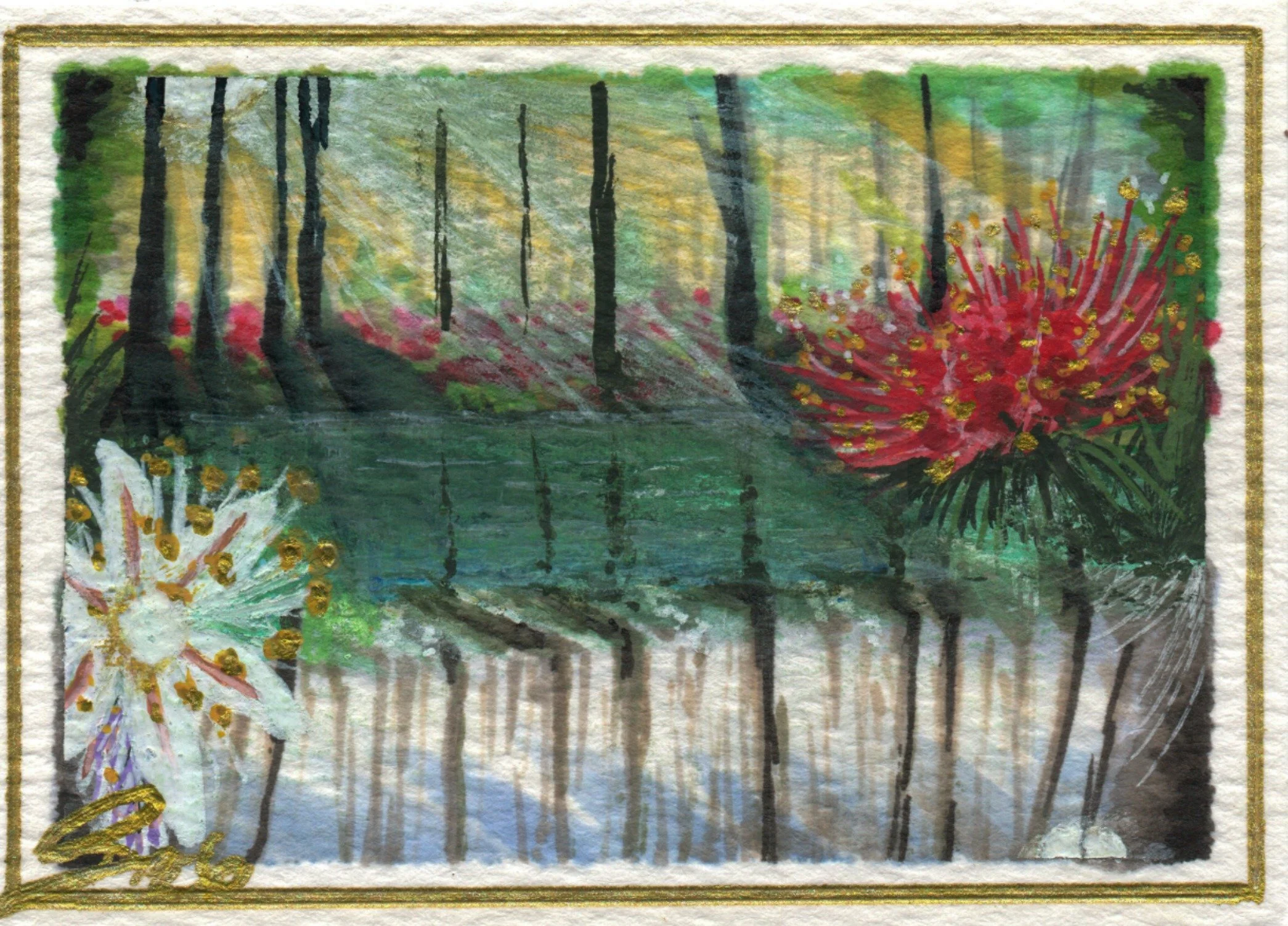
If two traditions imagine another shore, where might their paths meet?
Encounter
The Story Behind the Window
In Greek poetry, the asphodel meadow belongs to the landscape of the dead. Its precise character changes across texts and later interpretations, but asphodel became deeply associated with the afterlife and the chthonic world. In Japan, the red spider lily is commonly called higanbana: the flower of higan, the “other shore” associated with Buddhist observance, remembrance, and passage beyond the currents of ordinary existence. These traditions are historically distinct. Koete Asphodel Meadows does not claim that Greek and Japanese beliefs share one origin. It creates an imagined crossing between them.
Interpretation
Within the Artwork
Red spider lilies and pale asphodel occupy a composition intended to be viewed in more than one orientation. Turning the work changes which growth appears to rise and which seems to descend. The title joins the Japanese word koete—“crossing,” “going beyond,” or “surpassing”—to the Greek meadow. The flowers do not decorate death; they act as guides, provisions, and markers of passage. In Jones’s interpretation, the traveler is never pictured. The viewer occupies that place, deciding which direction leads beyond and whether the threshold represents departure, arrival, or return.
When the artwork is turned, have the flowers changed—or has the traveler?
Return
The Artist’s Thread
Jones combines red spider lily and asphodel because each carries an association with those who have passed, though within different cultural worlds. The dual orientation preserves that distinction while allowing the viewer to imagine movement between them.
Discovery
Follow the Thread
- Steve Reece: Homer’s Asphodel Meadow A scholarly study of asphodel, Homeric language, and the Greek afterlife.
- Homer, Odyssey, Book XXIV The Homeric journey of souls to the asphodel meadow.
- Royal Botanic Gardens, Kew: Lycoris radiata Botanical authority for the red spider lily; cultural meaning should be sourced separately on-page.
The Alignment Bloom
You are viewing Octant VII of VIII.
This Microcosm is one of eight independently held windows forming Masterpieces of the Macrocosm. The highlighted aperture identifies its permanent position within the Alignment.
Symbol standard: LUMA-AB-2026.1
Art → Thought → Curiosity → Action → Discovery → Understanding → Art