
Discovery II of VIII
Jō and Uba
MA-ACEO-002
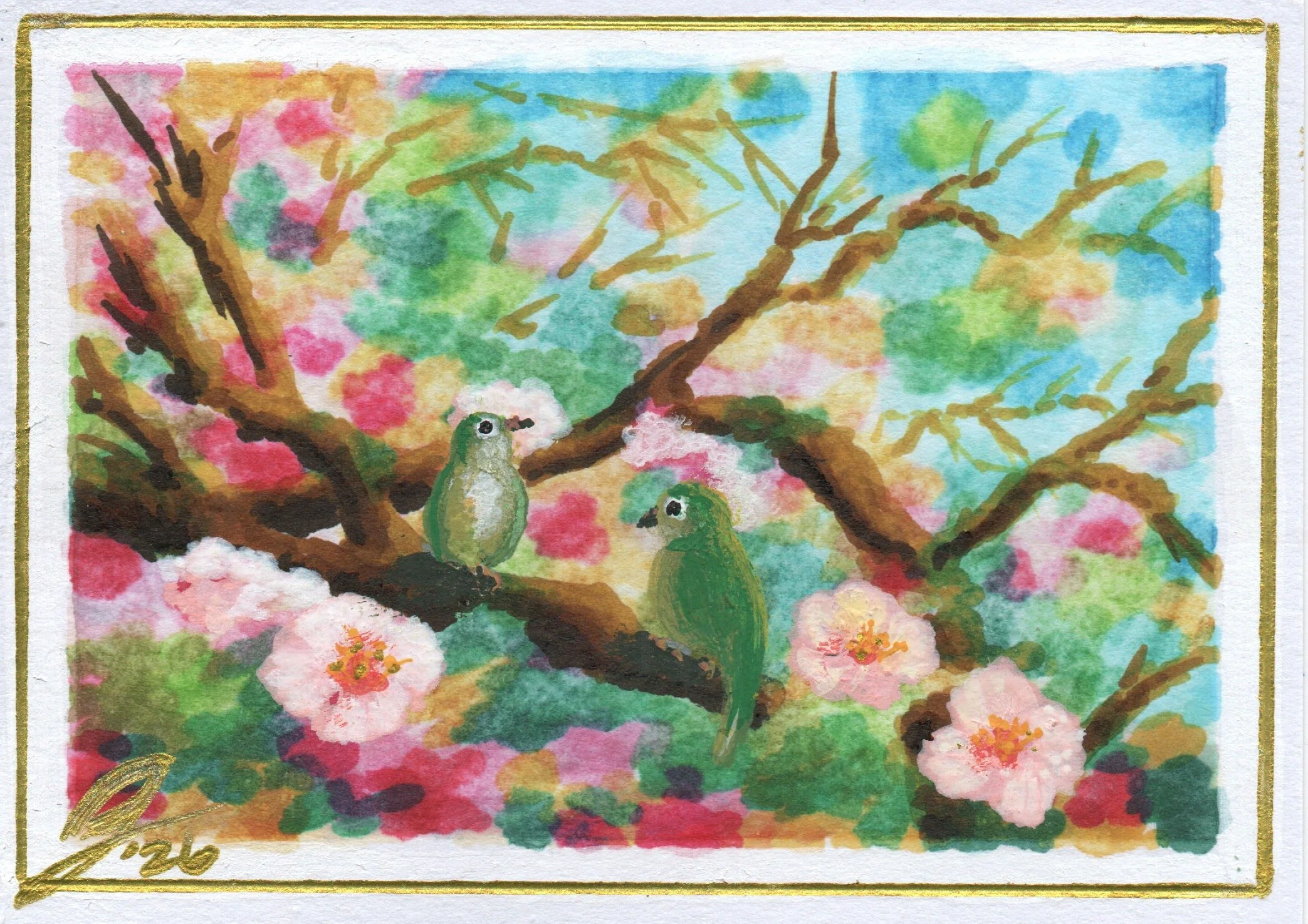
Can two lives grow separately and still become one enduring story?
Encounter
The Story Behind the Window
In the Japanese Noh play Takasago, an old man and woman appear beside celebrated pine trees. They are commonly known as Jō and Uba and revealed as spirits of the paired pines of Takasago and Sumiyoshi. Although rooted in different places, the trees—and the couple—express harmony, fidelity, longevity, and continuity across distance. Pine remains green through the seasons, making it an apt image for endurance. The story became a lasting subject in Japanese visual and performing arts, especially in objects associated with marriage and long life. Jō and Uba do not represent love as a single dramatic moment. Their meaning lies in duration: two presences weathering time without losing their relationship to one another.
Interpretation
Within the Artwork
The traditional elderly couple is not shown literally. Jones translates their companionship into two green birds sharing a flowering branch. They face one another without touching, distinct but held within the same living structure. Blossoms suggest the brevity of a season; the branch suggests what supports life beyond any one bloom. By replacing human figures with birds, the painting opens the story beyond marriage alone. It may speak to any bond that persists while both lives continue to change. The work is an artistic response to Takasago, not a traditional depiction of the Noh characters.
Do the birds share the branch because they arrived together—or because they have chosen to remain?
Return
The Artist’s Thread
The painting holds companionship within a moment of abundant life. Its two birds are individuals, not mirror images. Their closeness is meaningful precisely because neither disappears into the other.
Discovery
Follow the Thread
- The Metropolitan Museum of Art: Jō and Uba A Japanese inrō depicting Jō and Uba with the pine trees from Takasago.
- British Museum: Uba Museum context identifying Jō and Uba as spirits of the Takasago pines.
- Seattle Art Museum: Jō and Uba A Hokusai treatment demonstrating the story’s place in Japanese art.
The Alignment Bloom
You are viewing Octant II of VIII.
This Microcosm is one of eight independently held windows forming Masterpieces of the Macrocosm. The highlighted aperture identifies its permanent position within the Alignment.
Symbol standard: LUMA-AB-2026.1
Art → Thought → Curiosity → Action → Discovery → Understanding → Art